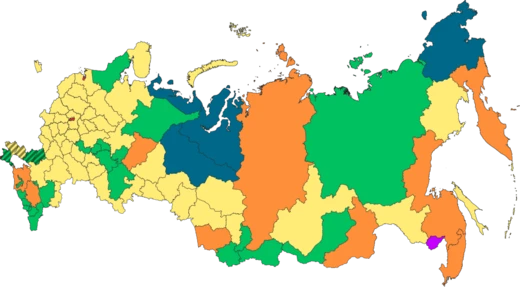
Udmurtia
A Finno-Ugric republic in Russia, centered on Izhevsk.

Udmurtia, officially the Udmurt Republic, is a republic of Russia located in Eastern Europe, administratively part of the Volga Federal District. Its capital is the city of Izhevsk. Established on 4 November 1920 as the Votyak Autonomous Oblast (renamed Udmurt Autonomous Oblast in 1932 and reorganized into the Udmurt ASSR in 1934), it is one of the Finno-Ugric National Regions and Republics within Russia, home to the Udmurt people, whose name derives from 'odo-mort' ('meadow people').
- Established
- 4 November 1920
- Capital
- Izhevsk
- Population (2021 census)
- 1,452,914
- Area
- Located west of the Ural Mountains, between the Kama and Vyatka rivers
- Official status
- Republic of Russia, Volga Federal District
- Ethnic groups (2021)
- Russians 67.7%, Udmurts 24.1%, Tatars 5.5%
Lore & Background
The Votyaks are considered the only Finno-Ugric people still settled in the ancestral homeland of the Finno-Ugric peoples. After ancestors of the Syrians migrated north around the 8th–9th centuries, the Votyaks began independent development, sharing historical periods with other Volga Finno-Ugric peoples, including Volga-Bulgarian relations from the 8th–9th centuries to 1236. During World War II, many industrial factories were evacuated from the Ukrainian SSR and western borderlands to Udmurtia. On 11 October 1991, the Supreme Council of the Udmurt ASSR renamed it the Udmurt Republic.
Reader's Guide
Udmurtia holds significance as a distinct Finno-Ugric republic within the Russian Federation, preserving the language and culture of the Udmurt people, who are a minority in their own republic (24.1% of the population as of 2021). Its history reflects broader patterns of Russian and Soviet administrative reorganization, from autonomous oblast to ASSR to republic. The republic's industrial base was bolstered by wartime evacuations, and its capital Izhevsk remains a major administrative, industrial, and cultural center. The Udmurt Jews developed a unique Yiddish variety, Udmurtish, with Udmurt and Tatar loanwords. Religiously, the population is diverse, with Russian Orthodoxy (33.1%), Islam (4%), and native faiths (2%) among others, alongside a high percentage of spiritually unaffiliated and atheist residents. The republic's moderate continental climate and location between the Kama and Vyatka rivers define its geography.
Did You Know?
- The name Udmurt derives from 'odo-mort', meaning 'meadow people', with the root 'odo' from a Permic word for 'meadow'.
- Udmurtia was originally established as the Votyak Autonomous Oblast on 4 November 1920.
- The Udmurt Jews developed a local Yiddish variety called Udmurtish, divided into central and southern subgroups.
- According to a 2012 survey, 29% of Udmurtia's population declared themselves 'spiritual but not religious'.
More in Russian Federal Subjects 1-20
Spotted an error? Know more?
This is a living reference — every entry is fact-audited, and reader corrections feed straight into our audit queue. Suggest an edit · See this site's audit record