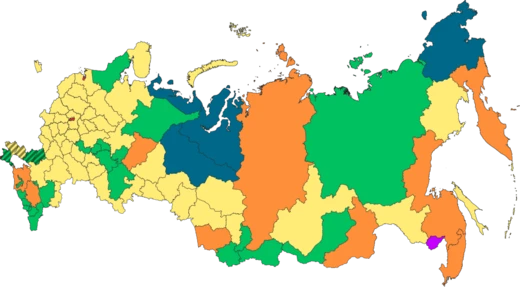
Tatarstan
A Russian republic with a rich Volga Bulgar and Tatar heritage.

Tatarstan, officially the Republic of Tatarstan and also known as Tataria, is a federal subject of Russia situated in Eastern Europe. It belongs to the Volga Federal District, and its capital, Kazan, serves as a major cultural hub for the country. The republic’s economy relies heavily on oil extraction and a robust petrochemical industry.
The republic’s name combines the ethnonym “Tatars” with the Persian suffix “-stan,” meaning “state” or “country.” During the Soviet era, the Russian name “Tatariya” was used alongside “Tatar ASSR.” Alternative spellings include “Tataristan” in Turkish and, occasionally, “Tatarıstan” in Tatar. Besides the official “Tatarstan respublikası,” the name “Tatarstan Cömhüriyäte” is also employed.
Geographically, Tatarstan lies on the East European Plain, about 800 kilometers east of Moscow, between the Volga and Kama Rivers, extending toward the Ural Mountains. Oak dominates 87% of the forested area, with aspen, linden, birch, and Scots pine also present. Forest cover has dropped from 51.2% to 17.1% over the last three centuries. The Volga-Kama Nature Reserve is located here. The republic spans 68,000 square kilometers (0.4% of Russia’s total area) and, as of the 2021 census, had a population of 4,004,809. Its highest point reaches 381 meters, with a maximum north–south distance of 290 kilometers and east–west distance of 460 kilometers.
Tatarstan borders Kirov Oblast to the north, the Udmurt Republic to the north and northeast, Bashkortostan to the east and southeast, Orenburg Oblast to the southeast, Samara and Ulyanovsk Oblasts to the south and southwest, and the Chuvash Republic and Mari El Republic to the west and northwest. Major rivers include the Volga, Kama, Vyatka, Belaya, Ik, Kazanka, Zay, and Azevka. Key reservoirs are the Kuybyshev, Lower Kama, and Zainsk. The largest lake is Kaban, and the largest swamp is Kulyagash. Prominent uplands are the Bugulma-Belebey Upland, Volga Upland, and Vyatskiye Uvaly. Natural resources include oil, natural gas, and gypsum, with estimated oil deposits exceeding one billion tons. The climate features an average January temperature of −15°C, July average of +18°C, annual average of +4°C, and annual precipitation of 500 to 550 mm.
Administratively, Tatarstan comprises 43 municipal districts, 2 urban districts (Kazan and Naberezhnye Chelny), 39 urban settlements, and 872 rural settlemen
- capital
- Kazan
- area
- 68,000 square kilometres (26,000 mi²)
- population
- 4,004,809 (2021 census)
- official_languages
- Tatar and Russian
- head_of_republic
- Rustam Minnihanov
- established
- Tatar ASSR founded in 1920; renamed Republic of Tatarstan in 1992
Lore & Background
The earliest known organised state within Tatarstan's boundaries was Volga Bulgaria, which adopted Islam in 922. This event is celebrated yearly in the city of Bolgar. Volga Bulgaria fell to Mongol prince Batu Khan in the late 1230s, and the region later became the Khanate of Kazan in the 1430s, which was conquered by Tsar Ivan the Terrible in the 1550s. In 1920, the modern Tatar state, the Tatar ASSR, was founded as an autonomous republic of the Russian SFSR, later renamed the Republic of Tatarstan in 1992.
Reader's Guide
Tatarstan's significance lies in its historical role as a centre of Volga Bulgar and Tatar statehood, its adoption of Islam in 922, and its modern status as a major oil-producing republic within Russia. The republic has strong cultural, linguistic, and ethnic ties with neighbouring Bashkortostan. Its capital, Kazan, is a key cultural centre. Tatarstan declared sovereignty in 1990 and held a referendum on a new constitution in 1992, which defined it as a sovereign state, though this was later declared unconstitutional by the Russian Constitutional Court. A power-sharing agreement with Moscow, signed in 1994, expired in 2017, making Tatarstan the last republic to lose its special status. The republic's official languages are Tatar and Russian, and its religious leaders include mufti Kamil Samigullin and metropolitan bishop Cyril Nakonechny.
Did You Know?
- Tatarstan's earliest known organised state was Volga Bulgaria, which adopted Islam in 922.
- The republic's main source of wealth is oil, with over one billion tons of estimated oil deposits.
- Tatarstan's forest cover decreased from 51.2% to 17.1% over the last 300 years.
- The name 'Tatarstan' derives from the Tatars and the Persian suffix -stan, meaning 'state' or 'country'.
More in Russian Federal Subjects 1-20
Spotted an error? Know more?
This is a living reference — every entry is fact-audited, and reader corrections feed straight into our audit queue. Suggest an edit · See this site's audit record