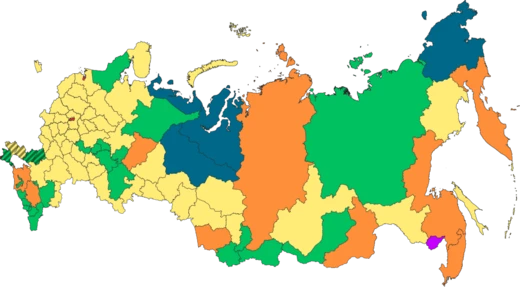
Dagestan
A diverse Russian republic in the North Caucasus mountains.

Dagestan, formally called the Republic of Dagestan, is a federal subject of Russia located in the North Caucasus region of Eastern Europe, with its eastern border along the Caspian Sea. Lying north of the Greater Caucasus mountain range, it belongs to the North Caucasian Federal District. As Russia’s southernmost point, it shares international borders with Azerbaijan to the south and Georgia to the southwest, as well as internal borders with the Russian republics of Chechnya to the west, Stavropol Krai to the northwest, and Kalmykia to the north. The capital and largest city is Makhachkala; other significant cities include Derbent, Kizlyar, Izberbash, Kaspiysk, and Buynaksk.
Covering 50,300 square kilometers (19,400 square miles), Dagestan has a population exceeding 3.1 million. It is home to more than 30 ethnic groups and 81 nationalities, with 14 languages granted official status. Twelve ethnic groups each account for over 1% of the total population, making Dagestan one of Russia’s most linguistically and ethnically diverse regions—and one of the most heterogeneous administrative divisions globally. Most residents speak a Northeast Caucasian or Turkic language, though Russian serves as the primary language and lingua franca. Internationally, Dagestan is noted for its strong tradition of combat sambo, with many practitioners later transitioning to mixed martial arts.
The name “Dagestan” combines the Turkic word *dağ* (mountain) with the Persian suffix *-stan* (land), meaning “land of the mountains.” Historically, parts of the region were known as Lekia, Avaria, and Tarki at different times. From 1860 to 1920, it was called the Dagestan Oblast, covering the southeastern portion of the present-day republic. The current borders were established in 1921 with the creation of the Dagestan Autonomous Soviet Socialist Republic, which incorporated the eastern part of the Terek Oblast—a low-lying area along the Terek littoral at the southern end of the Caspian Depression.
Geographically, Dagestan is situated in the North Caucasus mountains and is Russia’s southernmost territory. It spans a maximum of 400 kilometers (250 miles) north to south and 200 kilometers (120 miles) east to west. Its highest point is Mount Bazardüzü (also spelled Bazardyuzyu), reaching 4,446 meters (14,587 feet) on the border with Azerbaijan. The republic contains over 1,800 rivers, includin
- area
- 50,300 square kilometers (19,400 sq mi)
- population
- over 3.1 million
- capital
- Makhachkala
- official_languages
- 14 (including Russian, Avar, Dargin, Kumyk, Lezgian, Lak, Tabasaran, Rutulian, Aghul, Tsakhur, Nogai, Chechen, Azerbaijani, Tat)
- highest_point
- Mount Bazardüzü/Bazardyuzyu, 4,446 meters (14,587 ft)
- known_for
- strong culture of combat sambo; ethnolinguistic diversity
Lore & Background
The word Dagestan is of Turkic and Persian origin, directly translating to 'land of the mountains'. The Turkic word dağ means 'mountain', and the Persian suffix -stan means 'land'. Some areas of Dagestan were known as Lekia, Avaria and Tarki at various times. Between 1860 and 1920, Dagestan was referred to as Dagestan Oblast, corresponding to the southeastern part of the present-day republic. The current borders were created with the establishment of the Dagestan Autonomous Soviet Socialist Republic in 1921, with the incorporation of the eastern part of Terek Oblast.
In the first few centuries AD, Caucasian Albania became a vassal and eventually subordinate to the Parthian Empire. With the advent of the Sasanian Empire, it became a satrapy. In the 5th century, the Sassanids gained the upper hand, and by the 6th century had constructed a strong citadel at Derbent, known as the Caspian Gates. During the Islamic conquests, the Dagestani people (region of Derbent) were the first people to become Muslims within current Russian territory, after the Arab conquest of the region in 643. By the 15th century, Christianity had died away, leaving a 10th-century Church of Datuna as the sole monument to its existence.
In the second half of the 11th century, the Seljuk Turks took part of the region under their control. The Mongols raided the lands in 1221–1222 then conquered Derbent and the surrounding area from 1236 to 1239. The Timurids incorporated the region into their realm following the Mongols. As Mongolian authority gradually eroded, new centers of power emerged in Kaitagi and Tarki. In the early 16th century, the Persians (under the Safavids) reconsolidated their rule over the region, which would intermittently last till the early 19th century. In the 1720s, the Russians briefly annexed maritime Dagestan from the Safavids, but the territories were returned to Persia in 1735 per the Treaty of Ganja. Between 1730 and the early 1740s, Nader Shah led a lengthy campaign in Dagestan, but was forced to withdraw due to weather, disease, and heavy raids. From 1747 onwards, the Persian-ruled part of Dagestan was administered through the Derbent Khanate. The Persian expedition of 1796 resulted in the Russian capture of Derbent, but the Russians were again forced to retreat.
Reader's Guide
Dagestan's significance lies in its extreme ethnic and linguistic diversity, with 14 official languages and 12 ethnic groups each constituting more than 1% of its total population, making it one of the most heterogeneous administrative divisions in the world. Its location at the southernmost tip of Russia, along the Caspian Sea and bordering Azerbaijan and Georgia, has made it a historical crossroads for empires including the Parthian, Sasanian, Arab, Seljuk, Mongol, Timurid, Persian, Ottoman, and Russian. The republic's mountainous terrain, with the Greater Caucasus covering the south and the highest peak Bazardüzü at 4,446 meters, has shaped its distinct cultural and political development. Dagestan is also known internationally for its strong culture of combat sambo, with many fighters later turning to mixed martial arts. Its natural resources include oil, natural gas, coal, and many other minerals. The climate is continental, among the warmest in Russia, with average January temperatures of +2°C and July temperatures of +26°C. The legacy of Dagestan includes its role as the first region within current Russian territory to adopt Islam, following the Arab conquest in 643, and its enduring tradition of legal codification and autonomy among mountainous communities (djamaats) during the 16th and 17th centuries.
Did You Know?
- Dagestan has 14 official languages, including Avar, Dargin, Kumyk, Lezgian, Lak, Tabasaran, Rutulian, Aghul, Tsakhur, Nogai, Chechen, Azerbaijani, Tat, and Russian.
- The name Dagestan translates directly to 'land of the mountains' from Turkic and Persian.
- The highest point in Dagestan is Mount Bazardüzü/Bazardyuzyu at 4,446 meters (14,587 ft), on the border with Azerbaijan.
- Dagestan is known internationally for its strong culture of combat sambo, with many fighters later turning to mixed martial arts.
More in Russian Federal Subjects 1-20
Spotted an error? Know more?
This is a living reference — every entry is fact-audited, and reader corrections feed straight into our audit queue. Suggest an edit · See this site's audit record