Komi Republic
A Russian republic with vast forests, Gulag history, and UNESCO heritage.

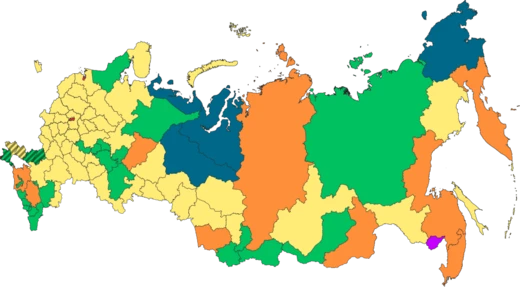
The Komi Republic, often shortened to Komi, is a federal subject of Russia located in the northeastern part of European Russia. Its administrative center is Syktyvkar. By area, it is the second-largest federal region in European Russia, trailing only Arkhangelsk Oblast. According to the 2021 census, its population stood at 737,853, a decline from 901,189 in 2010.
The Komi people first appear in historical records from the Novgorod Republic in the 11th century, when Novgorodian traders ventured into the Perm region for furs and hides. They called the area Zavolochye ("beyond the portage"), and referred to the Komi as "the Chud beyond the portage." The Moscow principality later expanded into Komi lands, accompanied by a surge in monastic activity during the 14th and 15th centuries under the Russian Orthodox Church. Stephen of Perm, a missionary from Ustyug, created the first alphabet for the Komi (then called Zyrians by Russians) and became the first bishop of Perm, settling in Ust-Vym. After Novgorod was annexed by Moscow, the Komi territories fell under Moscow’s influence in the late 15th and early 16th centuries. The site of Syktyvkar, settled from the 16th century, was originally known as Sysolskoye. In 1780, under Catherine the Great, it was renamed Ust-Sysolsk and used as a penal colony.
Russian exploration of Komi territory intensified in the 19th and early 20th centuries, beginning with an 1843 expedition led by Alexander von Keyserling. This revealed abundant mineral deposits and timber. Following the founding of the Soviet Union in 1922, the Komi-Zyryan Autonomous Oblast was established on August 22, 1921, and on December 5, 1936, it was reorganized into the Komi Autonomous Soviet Socialist Republic, with Syktyvkar as its administrative center. Many early 20th-century settlers were Gulag prisoners, sent by the hundreds of thousands for forced labor in the Arctic. Towns emerged from labor-camp sites, with the first mine, "Rudnik No. 1," becoming the city of Vorkuta. Prisoners planned and built all major cities in the republic, including Syktyvkar, Pechora, Vorkuta, and Inta, as well as its railways, roads, and industrial infrastructure. On March 21, 1996, the Komi Republic signed a power-sharing agreement with Russia, granting it autonomy, but this was abolished on May 20, 2002.
Geographically, the republic lies west of the Ural Mountains, on the n
- Capital
- Syktyvkar
- Area
- 415,900 square kilometers
- Population (2021 census)
- 737,853
- Highest point
- Mount Narodnaya (1,894 m)
- Official language
- Russian (Komi also recognized)
- Head of government (2024)
- Rostislav Goldshteyn
Lore & Background
The Komi people first appear in records of the Novgorod Republic in the 11th century, when traders from Novgorod traveled to the Perm region for furs and hides. The Novgorodians called these lands Zavolochye, and the Komi were referred to as 'the Chud beyond the portage.' After Novgorod was annexed by Moscow, the Komi territories came under Moscow's influence in the late 15th and early 16th century. The site of Syktyvkar, settled from the 16th century, was known as Sysolskoye; in 1780, under Catherine the Great, it was renamed Ust-Sysolsk and used as a penal colony.
In the 19th and early 20th centuries, Russians explored the Komi territory extensively, starting with an expedition led by Alexander von Keyserling in 1843, finding reservoirs of minerals and timber. After the founding of the Soviet Union in 1922, the Komi-Zyryan Autonomous Oblast was established on August 22, 1921, and on December 5, 1936, it was reorganized into the Komi Autonomous Soviet Socialist Republic. Many early 20th-century settlers were Gulag prisoners, sent by the hundreds of thousands for forced labor; towns like Vorkuta, Ukhta, Pechora, and Inta originated from labor-camp sites. Prisoners built the republic's major cities, railways, roads, and industrial infrastructure.
On 21 March 1996, the Komi Republic signed a power-sharing agreement with the government of Russia, granting it autonomy; the agreement was abolished on 20 May 2002. The republic is home to Manpupuner, a site of seven rock towers known as the '7 Strong Men,' deemed one of the Seven Wonders of Russia.
Reader's Guide
The Komi Republic holds significance as a region shaped by centuries of Russian expansion, Soviet forced labor, and natural resource extraction. Its history reflects the broader patterns of Russian colonization of the north, with Novgorodian and Muscovite influence, missionary activity by Stephen of Perm (who created the first Komi alphabet), and later exploitation of coal, oil, gas, gold, diamonds, and timber. The Gulag system left a profound mark, as prisoners built the republic's major cities and infrastructure. The republic's demographic decline from 901,189 in 2010 to 737,853 in 2021 mirrors trends in many Russian regions. Ecologically, the Virgin Komi Forests, a UNESCO World Heritage Site, represent the largest expanse of virgin forests in Europe. Politically, the short-lived power-sharing agreement of 1996–2002 highlights attempts at regional autonomy within Russia. The republic's economy remains dominated by oil, wood, and paper industries, which made up 94.5% of exports in 2021.
Did You Know?
- The Komi Republic is the second-largest federal region by area in European Russia after Arkhangelsk Oblast.
- The lowest recorded temperature in the republic is −58.1 °C (−72.6 °F) at the village of Ust-Shchuger.
- The Virgin Komi Forests, covering about 32,800 km², were the first natural UNESCO World Heritage Site in Russia.
- Prisoners of the Gulag built the republic's major cities, including Syktyvkar, Vorkuta, Ukhta, Pechora, and Inta.
More in Russian Federal Subjects 1-20
Spotted an error? Know more?
This is a living reference — every entry is fact-audited, and reader corrections feed straight into our audit queue. Suggest an edit · See this site's audit record