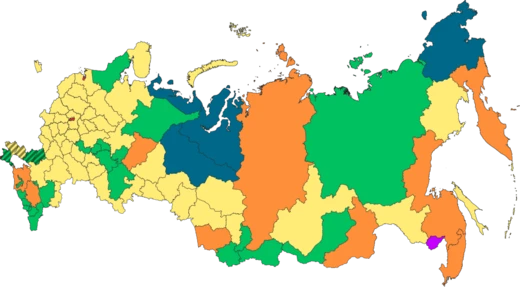
Mari El
A Russian republic for the indigenous Mari people.

Mari El, officially the Mari El Republic, is a republic of Russia located in the European region of the country along the northern bank of the Volga River. It is administratively part of the Volga Federal District and was established for the indigenous Mari people, a Finno-Ugric nation. The republic's capital and largest city is Yoshkar-Ola.
- Population
- 696,459 (2010 Census)
- Capital
- Yoshkar-Ola
- Official Languages
- Russian and Mari
- Area
- Part of the East European Plain, along the Volga River
- Established
- Mari Autonomous Oblast on 4 November 1920; reorganized into Mari ASSR on 5 December 1936; present form on 22 December 1990
Lore & Background
Mari El was established as an ethnic republic for the Mari people, a Finno-Ugric nation known since the 5th century. The area was historically a tributary of Volga Bulgaria and the Golden Horde, later incorporated into the Khanate of Kazan and occupied by the Tsardom of Russia after 1552. Under the Bolshevik regime, the Mari Autonomous Oblast was created on 4 November 1920, later reorganized into the Mari ASSR on 5 December 1936. The present Mari El Republic was formed on 22 December 1990, and on 21 May 1998 it signed a power-sharing agreement with the federal government, which was abolished on 31 December 2001.
Reader's Guide
Mari El is significant as one of Russia's ethnic republics, preserving the culture and language of the Mari people, a Finno-Ugric nation. The republic's population is majority ethnic Russian (52.5%) with a significant Mari minority (40.1%), and its official languages are Russian and Mari. The traditional Mari religion (Chimari yula) is still practiced, alongside Russian Orthodoxy and Islam, though human rights groups have reported repression of Mari culture and language since 2005. The republic's economy relies on machine construction, timber, and food industries, and its geography features numerous rivers, lakes, and swamps. Mari El's legacy includes its role in maintaining Mari identity and its complex interethnic relations within the Russian Federation.
Did You Know?
- The republic's name comes from the Mari word 'Mari' (man, husband) and 'el' (country, land).
- Lake Yalchik is the largest lake in the republic by area, occupying 150 hectares.
- The highest point in Mari El is 278 meters (912 feet) above sea level.
- About 50% of the republic's territory is forested.
Geography & Natural Environment
Nestled in the eastern reaches of the East European Plain, the Mari El Republic stretches along the northern bank of the Volga, its landscape defined by water. The west is dominated by the low-lying, swamp-ridden Mari Depression, while the east rises into rolling hills peaking at 278 metres. Some 476 rivers thread the territory, most narrow channels ten to fifty metres wide and under a metre and a half deep, freezing from mid-November through mid-April. Over seven hundred lakes and ponds dot the terrain, many tucked into marshy lowlands and covering less than a square kilometre. Lake Yalchik, at roughly 150 hectares, is the largest by area; Lake Tabashinskoye is the deepest. Vast wetland complexes, some spanning up to 100 square kilometres, render large stretches impassable during spring and autumn floods. The climate is moderately continental—summers warm and rainy around 18 to 20 degrees Celsius, winters cold and snowy at minus 18 to minus 20. November brings the strongest winds, and annual precipitation falls between 450 and 500 millimetres. About half the territory is forested, though density varies by district. The republic holds virtually no industrially significant mineral deposits; its extractable resources are limited to peat, mineral springs, and limestone.
History & Political Evolution
The Mari people have inhabited the Volga-Kama region since at least the fifth century, though archaeological evidence suggests their cultural roots reach even further back. For centuries their lands served as tributary territory to Volga Bulgaria and later the Golden Horde. In the 1440s the area was absorbed into the Khanate of Kazan, and following the fall of Kazan in 1552, the Tsardom of Russia under Ivan the Terrible took direct control. The modern political structure began after the 1917 Revolution: the Bolsheviks established the Mari Autonomous Oblast on 4 November 1920, and the entity was reorganised as the Mari ASSR on 5 December 1936, coinciding with the adoption of the 1936 Soviet Constitution. The republic assumed its present form on 22 December 1990. In May 1998, Mari El signed a power-sharing agreement with the federal government—alongside Amur, Ivanovo, Kostroma, and Voronezh Oblast—that granted it additional autonomy, though the arrangement was dissolved on 31 December 2001. The name itself carries deep cultural meaning: 'Mari' derives from the word for 'man' or 'husband,' and 'El' means 'country' or 'land,' together signifying the homeland of the Mari people.
Demographics & Religious Life
Though the Mari people have lived along the Volga and Kama for millennia, they did not possess a designated territorial entity before the 1917 Revolution. Today the republic's population of roughly 696,000 (2010 census) is a mosaic: ethnic Russians form a majority at 52.5 percent according to the 2021 Census, up from 47.4 percent in 2010, while the Mari make up 40.1 percent, down from 43.9 percent. Tatars account for 4.8 percent and Chuvash for 0.6 percent. Notably, only 58.2 percent of all Mari within Russia reside in the republic; another 20.1 percent live in Bashkortostan, where the Eastern Mari settled to escape religious persecution. The spiritual landscape is equally layered. Russian Orthodoxy, the indigenous Mari faith known as Chimari yula, the Old Believer tradition, and Islam all have significant followings. The Czars once resorted to blowing up a sacred mountain to suppress Mari worship, and persecution continued under Soviet rule. In the 1990s the state officially recognised the religion, sparking a revival. Mari communities now gather at around 520 holy groves to offer animal and vegetable sacrifices, and a syncretic blend with Christianity persists among many practitioners.
Political Landscape & Cultural Tensions
The head of government in Mari El—formerly styled president—has changed hands in recent years. Alexander Yevstifeyev was appointed in April 2017 and served a single term before resigning in 2022. Yury Zaitsev stepped in as acting head and was formally elected in September 2022. The republic's political climate has not been without friction. After 2005, interethnic relations soured under President Leonid Markelov amid allegations of systematic repression of Mari cultural expression. In 2006, the International Helsinki Federation for Human Rights and the Moscow Helsinki Group jointly published a report documenting significant obstacles to the use of the Mari language in public settings and identifying what they described as a broader pattern of suppressing dissident voices within the republic. Despite these tensions, both Russian and Mari hold official language status. The republic is bordered by Nizhny Novgorod Oblast to the west, Kirov Oblast to the north, Tatarstan to the east, and Chuvashia to the south, placing it at a crossroads of several distinct ethnic and cultural traditions within the Volga Federal District.
More in Russian Federal Subjects 1-20
Spotted an error? Know more?
This is a living reference — every entry is fact-audited, and reader corrections feed straight into our audit queue. Suggest an edit · See this site's audit record