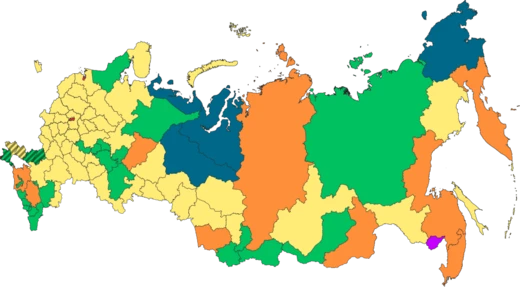
Ingushetia
Smallest Russian republic, home to the Ingush people.

Ingushetia, officially the Republic of Ingushetia, is one of Russia’s federal subjects, situated in the North Caucasus region of Eastern Europe. It belongs to the North Caucasian Federal District and borders Georgia to the south, the Russian republics of North Ossetia–Alania to the west and north, and Chechnya to the east and northeast. Its capital is the town of Magas, though the largest city is Nazran. Covering just 3,600 square kilometers, it is the smallest non-city federal subject in Russia. The republic was created on 4 June 1992, when the Checheno-Ingush Autonomous Soviet Socialist Republic was divided into two separate entities. The native population is the Ingush, an indigenous people of Nakh descent. According to the 2021 Census, the population was estimated at 527,220.
Ongoing instability linked to the insurgency in the North Caucasus has left Ingushetia among Russia’s poorest and most volatile regions. While violence has lessened in recent years, conflict in neighboring Chechnya has occasionally spilled over into Ingushetia. A 2008 report by Human Rights Watch highlighted that the republic has been destabilized by corruption, serious crimes—including kidnappings and murders of civilians by government security forces—anti-government protests, attacks on soldiers and officers, Russian military excesses, and a worsening human rights situation. Despite these challenges, Ingushetia recorded the highest life expectancy in all of Russia as of 2017.
The name “Ingushetia” comes from the Russian name for the Ingush people, which itself derives from the ancient Ingush village of Angusht, combined with the Georgian suffix “-éti.” In the Ingush language, the republic is called Ghalghaaichie (Гӏалгӏайче). During the 1920s and 1930s, there was no single agreed-upon name for the Ingush Autonomous Oblast. Although it was officially called Ingushetia, some scholars, such as Nikolai Yakovlev and Leonid Semyonov, argued that the correct name should be Ingushiya.
In the 18th century, the Ingush were mostly pagan and Christian, with a Muslim minority. From 1588 onward, some Chechen societies aligned with Russia. Russian historians often claim that the Ingush voluntarily joined Russia, citing a document signed on 13 June 1810 by General-Major Delpotso and representatives of two Ingush clans. However, most other clans resisted Russian conquest. In 1811, the Russian e
- established
- 4 June 1992
- capital
- Magas
- largest_city
- Nazran
- area_sq_km
- 3600
- population_2021
- 527220
- life_expectancy_rank
- highest in Russia as of 2017
- status
- republic of Russia
Lore & Background
The name Ingushetia derives from the Russian name of the Ingush, which comes from the ancient Ingush village Angusht and the Georgian suffix -éti. In Ingush it is called Ghalghaaichie. In the 1920–1930s there was no unifying name for the Ingush Autonomous Oblast; some scientists insisted on Ingushiya. The republic was established on 4 June 1992 after the Checheno-Ingush Autonomous Soviet Socialist Republic was split in two.
Reader's Guide
Ingushetia is significant as the smallest non-city federal subject of Russia, established in 1992 following the dissolution of the Checheno-Ingush ASSR. It is the homeland of the Ingush people, a Nakh group, and has a population of 527,220 as of the 2021 Census. Despite its small size, the republic has faced severe challenges: it remains one of the poorest and most unstable regions of Russia, largely due to the insurgency in the North Caucasus. Violence has declined in recent years, but the insurgency in neighboring Chechnya has occasionally spilled over. Human Rights Watch in 2008 reported destabilization from corruption, high-profile crimes including kidnapping and murder by government security forces, anti-government protests, attacks on soldiers, Russian military excesses, and a deteriorating human rights situation. Paradoxically, as of 2017, Ingushetia had the highest life expectancy in all of Russia. Its history includes resistance to Russian conquest in the 19th century, colonization and renaming of Ingush villages, and a period as part of the Mountainous Republic of the Northern Caucasus after the 1917 Russian Revolution.
Did You Know?
- Ingushetia is the smallest of Russia's non-city federal subjects, at 3,600 square km.
- The republic was established on 4 June 1992 after the Checheno-Ingush Autonomous Soviet Socialist Republic was split.
- As of 2017, Ingushetia had the highest life expectancy in all of Russia.
- The name Ingushetia derives from the ancient Ingush village Angusht and the Georgian suffix -éti.
More in Russian Federal Subjects 1-20
Spotted an error? Know more?
This is a living reference — every entry is fact-audited, and reader corrections feed straight into our audit queue. Suggest an edit · See this site's audit record