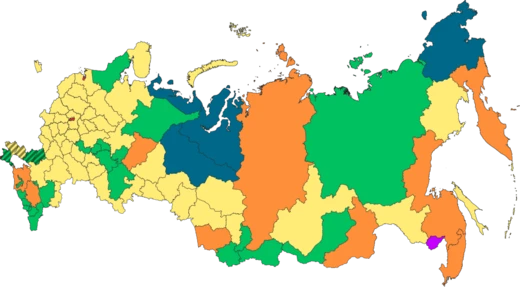
North Ossetia
A Russian republic with Alan heritage and Ossetian identity.

North Ossetia–Alania is a republic of Russia located in the North Caucasus of Eastern Europe. It is significant as a region with a distinct Iranian ethnic identity, the Ossetians, and a history rooted in the medieval Kingdom of Alania, which adopted Christianity in the 9th century. The republic has experienced internal conflicts, including the 1992 Ossetian-Ingush war and the 2004 Beslan school siege, and remains central to proposals for uniting with South Ossetia.
- Capital
- Vladikavkaz
- Population (2021 Census)
- 687,357
- Area
- 8,000 square kilometers (3,100 sq mi)
- Highest Point
- Mount Kazbek (5,033 m)
- Official Name
- Republic of North Ossetia–Alania
- Major Ethnic Group
- Ossetians (68.1%)
- Dominant Religion
- Eastern Orthodox Christianity
Lore & Background
The Ossetia region traces its history to the ancient Alans, who founded the Kingdom of Alania in the 8th century and adopted Christianity in the 9th century. The kingdom fell to the Mongols in the 13th century, after which the Alans fled to mountain gorges. From 1774 to 1806, Ossetia was slowly incorporated into the Russian Empire, which split the region into northern and southern parts. During the Soviet period, North Ossetia became the Mountain Autonomous Soviet Socialist Republic, then the North Ossetian Autonomous Oblast in 1924, and finally the North Ossetian Autonomous Soviet Socialist Republic in 1936. In World War II, Nazi German invaders unsuccessfully tried to seize Vladikavkaz in 1942.
Reader's Guide
North Ossetia–Alania's significance lies in its role as a crossroads of cultures and conflicts in the North Caucasus. The republic's Ossetian majority speaks an East Iranian language descended from Alanic and Sarmatian, and practices a mix of Eastern Orthodox Christianity and the ethnic religion Uatsdin. The region's history includes the ancient Silk Road trade, Mongol invasions, and incorporation into the Russian Empire. In the post-Soviet era, North Ossetia experienced ethnic war with Ingush in 1992 and spillover from the Chechen conflict, notably the 2004 Beslan school siege. Proposals to annex South Ossetia and unite the two regions persist. The republic's cuisine, especially Ossetian pies like Fydzhin and the symbolic 'three pies,' remains a key cultural marker.
Did You Know?
- The republic's name was officially changed to North Ossetia–Alania in November 1994.
- Mount Kazbek, at 5,033 meters, is the highest point in the republic.
- Almost 30% of the population adheres to the Ossetian ethnic religion Uatsdin.
- The 2004 Beslan school siege was carried out by Chechen terrorists.
Ancient Roots: The Alans and the Silk Road
The Ossetian people trace their lineage to the ancient Alans, an Iranian-speaking group whose medieval Kingdom of Alania was established in the eighth century. According to the tenth-century Arab geographer Al-Masudi, this kingdom's territory stretched from Dagestan all the way to Abkhazia, placing it at a crossroads of Eurasian trade. The Silk Road threaded through Alan lands, and the kingdom profited enormously from this commercial artery. The Alans adopted Christianity in the ninth century, a faith that would endure for centuries. However, the thirteenth century brought catastrophe: in 1220, Genghis Khan dispatched his generals Subutai and Jebe on a sweeping campaign that included Alania among its targets. By 1239, the capital Maghas and other cities lay in ruins, and the surviving Alans were driven into the mountain gorges, abandoning the fertile lowlands they had long inhabited. This traumatic displacement reshaped the demographic and cultural landscape of the region for generations to come.
A Distinctive Identity: Language, Faith, and Cuisine
North Ossetia stands apart from much of the North Caucasus in both linguistic and religious terms. The Ossetians, who make up roughly 68 percent of the republic's population, belong to the Iranian branch of the Indo-European family, and their language descends from the medieval Alanic tongue, which in turn grew out of ancient Sarmatian. This places them in a strikingly different cultural orbit from their Turkic and Semitic-speaking neighbors. Religiously, the majority of Ossetians are Eastern Orthodox Christians, a legacy of the ninth-century conversion of the Alans. Nearly thirty percent of residents practice Uatsdin, the indigenous Ossetian faith whose name translates as "True Faith," while a significant Muslim minority also calls the republic home. In the culinary sphere, Ossetian pies carry deep symbolic weight; the traditional "three pies" represent the Sun, the Earth, and water, and dishes like Fydzhin, a meat-filled pie, remain a cornerstone of everyday and ceremonial food culture.
The Revival of Alania: Naming a Nation
In the turbulent final years of the Soviet Union, nationalist currents swept across the Caucasus, and Ossetian intellectuals seized the moment to reclaim a name from deep history. They championed the revival of "Alania," the title of the medieval kingdom their ancestors had built in the eighth century. The term quickly permeated everyday Ossetian life: enterprises, television channels, political and civic organizations, publishing houses, and even a football team all adopted the name. The momentum was undeniable, and in November 1994 the republic's official title was formally expanded to the Republic of North Ossetia–Alania. This was not merely a bureaucratic rename; it represented a conscious effort to reconnect a modern population with a pre-Mongol heritage that had been severed by centuries of imperial and Soviet administration. The choice of Alania over purely Russian or Soviet-era designations signaled a desire to anchor Ossetian identity in its own ancient narrative rather than in the frameworks imposed by successive empires.
Division and Conflict: The Wounds of the Twentieth Century
The Ossetian people have endured a painful division that dates back to the Russian Empire's administrative decisions in the early nineteenth century, when the region was split into a northern part under the Terek Oblast and a southern part under Georgian governorates. That partition hardened during the Soviet era, with North Ossetia becoming an autonomous republic within the Russian SFSR and South Ossetia an autonomous oblast within the Georgian SSR. The collapse of the Soviet Union turned this administrative split into a bitter political and military reality. In December 1990, the Georgian Supreme Soviet abolished the Ossetian autonomous enclave, triggering mass displacement across the border. In 1992, a brief but violent ethnic war erupted between Ossetians and the predominantly Muslim Ingush population in the Prigorodny District. The republic also suffered the devastating spillover of the Chechen conflict, most tragically in the 2004 Beslan school siege. To this day, proposals circulate for Russia to annex South Ossetia and reunite the two halves into a single entity.
More in Russian Federal Subjects 1-20
Spotted an error? Know more?
This is a living reference — every entry is fact-audited, and reader corrections feed straight into our audit queue. Suggest an edit · See this site's audit record