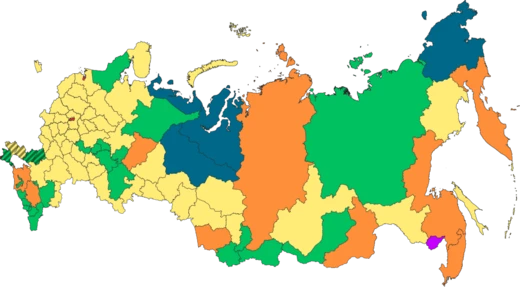
Karachay-Cherkessia
A multi-ethnic Russian republic in the North Caucasus.

Karachay-Cherkessia, formally called the Karachay-Cherkess Republic, is a federal subject of Russia situated in the North Caucasus and belongs to the North Caucasian Federal District. According to the 2021 census, its population stands at 469,865. The capital and largest city is Cherkessk. This republic is one of Russia’s ethnic-based administrative divisions, created to represent the indigenous Karachay and Cherkess (Circassian) peoples. The Karachay make up the largest share of the population at about 44%, followed by ethnic Russians at 27% and Cherkess at 13%. The Cherkess community is predominantly composed of the Besleney and Kabardin tribes. Five languages hold official status: Russian, Abaza, Cherkess (Kabardian), Karachay-Balkar, and Nogai.
Most of the republic’s land lies within the Caucasus Mountains, except for a narrow northern strip that belongs to the Don Steppe. It borders Krasnodar Krai to the west, Stavropol Krai to the northeast, Kabardino-Balkaria to the southeast, and Georgia to the southwest. Mount Elbrus, Europe’s tallest peak, sits on the border with Kabardino-Balkaria.
The republic occupies the northwestern slopes of the Caucasus, stretching 140 kilometers north to south and 170 kilometers east to west. Mountains cover 80% of its area. Water resources are abundant: 172 rivers flow through the territory, including the Kuban, Bolshoy Zelenchuk, Maly Zelenchuk, Urup, and Laba. There are roughly 130 glacial mountain lakes and many mineral springs. The climate is moderate, with short winters and long, warm, humid summers. Average January temperatures are −3.2 °C, and July averages +20.6 °C. Annual precipitation ranges from 550 millimeters on the plains to 2,500 millimeters in the mountains. Natural resources include gold, coal, and clays. Karachay-Cherkessia is the only region in the North Caucasian Federal District without an airport.
The Karachay-Cherkess Autonomous Oblast was established on 12 January 1922, early in the Soviet era. It was split on 26 April 1926 into the Karachay Autonomous Oblast and the Cherkess National Okrug, with the latter upgraded to an autonomous oblast on 30 April 1928. In November 1943, the Karachay Autonomous Oblast was dissolved after the Karachay people were accused of collaborating with the Nazis; about 70,000 were deported to the Kazakh and Uzbek republics. Most of the Karachay territory was divided bet
- Capital
- Cherkessk
- Population (2021 census)
- 469,865
- Largest ethnic group
- Karachays (44.4%)
- Official languages
- Russian, Abaza, Cherkess, Karachay-Balkar, Nogai
- Highest point
- Mount Elbrus (5,642 m), on border with Kabardino-Balkaria
- Federal district
- North Caucasian Federal District
Lore & Background
Karachay-Cherkessia was founded as an autonomous oblast on 12 January 1922 in the early years of the Soviet Union. It was split into Karachay Autonomous Oblast and Cherkess National Okrug on 26 April 1926. In November 1943, the Karachay Autonomous Oblast was abolished after the Karachay people were accused of collaboration with the Nazis; 70,000 were deported to the Kazakh and Uzbek republics. Most of the Karachay territory was split between Stavropol Krai and the Georgian SSR. The Cherkess Autonomous Oblast remained until 9 January 1957, when it was incorporated into the Karachay-Cherkess Autonomous Oblast in its former borders due to the rehabilitation of the Karachay.
Reader's Guide
Karachay-Cherkessia is significant as a multi-ethnic republic within Russia, reflecting the complex history of the North Caucasus. Its formation and dissolution during the Soviet era, including the deportation of the Karachay people in 1943 and their later rehabilitation, highlight the region's turbulent past. The republic's ethnic tensions, particularly between Karachays and Circassians, have shaped its politics, as seen in the disputed 1999 presidential election. Despite separatist activity being less intense than in Chechnya or Dagestan, militant groups have existed, and a car bomb in March 2001 was blamed on Chechen separatists. The republic is also notable for hosting major astronomical facilities, including the BTA-6 telescope (the world's largest from 1975 to 1993) and the RATAN-600 radio telescope.
Did You Know?
- Mount Elbrus, the highest mountain in Europe at 5,642 meters, is located on the border of Karachay-Cherkessia with Kabardino-Balkaria.
- Karachay-Cherkessia is the only region in the North Caucasian Federal District that does not have an airport.
- The republic has five official languages: Russian, Abaza, Cherkess (Kabardian), Karachay-Balkar, and Nogai.
- In November 1943, 70,000 Karachay people were deported to the Kazakh and Uzbek republics after being accused of collaboration with the Nazis.
Geography & Natural Landscape
Karachay-Cherkessia sprawls across the northwestern slopes of the Caucasus, stretching roughly 140 kilometers from north to south and 170 from east to west. Mountains dominate approximately 80 percent of the republic's land, lending it a dramatic alpine character, while a narrow band of flat terrain at the northern edge touches the Don Steppe. The republic's most celebrated landmark, Mount Elbrus at 5,642 meters, sits right on the border with Kabardino-Balkaria and holds the title of Europe's highest peak. Water is omnipresent: 172 rivers thread through the territory, with the Kuban, Bolshoy Zelenchuk, Maly Zelenchuk, Urup, and Laba being the largest. Around 130 glacial lakes dot the high country, and mineral springs are abundant. The climate is mild overall—January averages near −3.2 °C while July hovers around +20.6 °C—with precipitation ranging from 550 mm on the plains to 2,500 mm in the mountains. Subsoil wealth includes gold, coal, and various clays. Notably, despite its scenic appeal, Karachay-Cherkessia remains the only region in the North Caucasian Federal District without an airport.
Ethnic Mosaic & Linguistic Heritage
With a 2021 census population of roughly 470,000, Karachay-Cherkessia is a living tapestry of Caucasian and Turkic identities. The republic was created as a homeland for two principal peoples: the Caucasian-Turkic Karachays, who make up about 44 percent of residents, and the Cherkess (Circassians), accounting for roughly 13 percent. Ethnic Russians form the next largest group at 27 percent. The Cherkess population is primarily drawn from the Besleney and Kabardin tribal lineages. This diversity is reflected in the republic's five official languages—Russian, Abaza, Cherkess (Kabardian), Karachay-Balkar, and Nogai—making it one of the most linguistically layered regions in the North Caucasus. The capital and largest city, Cherkessk, sits at the crossroads of these communities. The administrative structure, with districts named after ethnic groups such as Adyge-Khablsky, Nogaysky, and Khabezsky, further underscores how deeply identity is woven into the political geography of the region.
Soviet Origins, Deportation, and Rebirth
The republic's political story begins in January 1922, when the early Soviet state established the Karachay-Cherkess Autonomous Oblast. By 1926 it had been split into separate Karachay and Cherkess units, and the Cherkess portion was elevated to autonomous oblast status in 1928. The darkest chapter arrived in November 1943: the Karachay Autonomous Oblast was dissolved, its people accused of collaborating with Nazi forces, and approximately 70,000 Karachays were forcibly deported to the Kazakh and Uzbek republics. Their former territory was divided between Stavropol Krai and the Georgian SSR. It was not until January 1957, following the rehabilitation of the Karachay, that the two entities were merged again into the Karachay-Cherkess Autonomous Oblast. In 1991 the oblast was upgraded to an Autonomous Soviet Socialist Republic, and in early 1992 President Yeltsin briefly moved to split it into separate Karachai, Cherkess, and Batalpashinsk regions. A March 1992 referendum saw the majority vote against partition, and by December 1992 the Karachay-Cherkess Republic was formally recognized.
Political Fractures & Contemporary Governance
Ethnic rivalry has been a persistent undercurrent in Karachay-Cherkessian politics. The first free regional presidential election in May 1999 pitted Karachay candidate Vladimir Semyonov against Circassian contender Stanislav Derev. Semyonov's victory triggered protests by Derev's supporters, who alleged widespread fraud and called for the republic's partition. The crisis was eventually defused through Moscow-led mediation and an independent judicial review that upheld the original result. Beyond electoral disputes, the region has faced low-level militant activity—though far less intense than in Chechnya or Dagestan. A 2001 car bomb that killed two people was attributed to Chechen separatists, and Muslim separatist cells have periodically clashed with Russian security forces, resulting in dozens of deaths. In September 2007, the FSB killed Rustam Ionov, known as "Abu-Bakar," head of the Karachaevo Jamaat, along with his wife. Today the republic is led by Rashid Temrezov, who holds the title of fead—a name adopted in 2012 to replace the earlier "President" designation.
More in Russian Federal Subjects 1-20
Spotted an error? Know more?
This is a living reference — every entry is fact-audited, and reader corrections feed straight into our audit queue. Suggest an edit · See this site's audit record