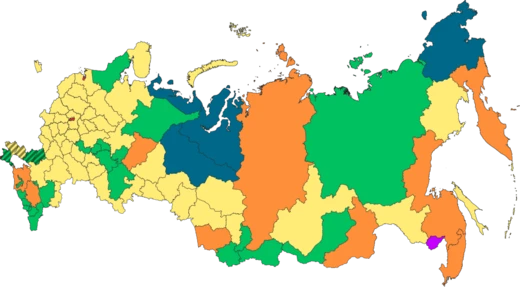
Khakassia
Republic of Russia in southern Siberia, known for natural beauty and resources.

Khakassia, officially the Republic of Khakassia, is a republic of Russia located in southern Siberia, situated between Krasnoyarsk Krai to the north and the Altai Republic to the south. The capital city is Abakan, and the region covers an area of about 61,900 square kilometres. The population is approximately 537,000, with the majority living in urban areas. The region is known for its natural beauty, with numerous rivers, lakes, and mountains, and for its traditional crafts and festivals.
- Capital
- Abakan
- Area
- 61,900 sq km
- Population (2010 census)
- 532,403
- Established as autonomous republic
- July 3, 1991
- Current name since
- 1992
- Highest point
- Kyzlasov Peak
- Largest river
- Yenisei
Lore & Background
The territory of modern Khakassia formed the core of the Yenisei Kirghiz state from the 6th century AD. In the 13th century, following defeat by the Mongols, most Kyrgyz migrated southwest to Central Asia; modern Khakas people regard themselves as descendants of those who remained. Khakassia was incorporated into the Russian state under Peter the Great, confirmed by the Treaty of Burya between Russia and China in 1729. Forts were constructed in 1707 and 1718, and many deported convicts remained after release. Many indigenous Khakas converted to Russian Orthodoxy and abandoned their nomadic way of life.
Reader's Guide
Khakassia's significance lies in its transformation from a core of the medieval Yenisei Kirghiz state to a modern republic within Russia. Under Soviet rule, the Khakas Autonomous Oblast was established on 20 October 1930, with borders identical to the modern republic. Until 1991, it was administratively subordinated to Krasnoyarsk Krai, then elevated to an Autonomous Soviet Socialist Republic in July 1991, and became the Republic of Khakassia in February 1992. The region's economy is based on coal mining, ore mining, and timber. Its natural resources include iron, gold, silver, coal, oil, and natural gas, with the largest molybdenum deposits in Russia. The population is predominantly Russian (82.1% in 2021), with ethnic Khakas at 12.7%. The republic has a unicameral Supreme Council and a head of government elected for five-year terms.
Did You Know?
- The highest point in Khakassia is Kyzlasov Peak.
- The Yenisei is the largest river in the republic.
- Molybdenum deposits in Khakassia are the largest in Russia.
- The Khakassky Nature Reserve is home to brown bears, wolves, and sable.
More in Russian Federal Subjects 1-20
Spotted an error? Know more?
This is a living reference — every entry is fact-audited, and reader corrections feed straight into our audit queue. Suggest an edit · See this site's audit record