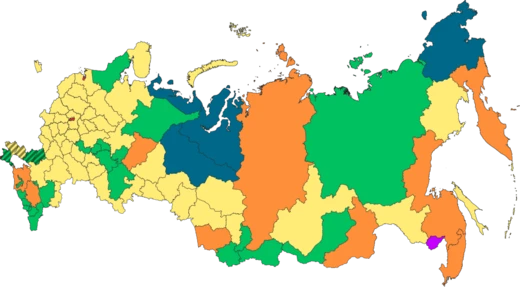
Kabardino-Balkaria
A North Caucasus republic home to Europe's highest peak.

Kabardino-Balkaria, officially the Kabardino-Balkarian Republic, is a republic of Russia located in the North Caucasus. Its capital is Nalchik, and as of the 2021 Census its population was 904,200. The republic contains Mount Elbrus, the highest mountain in Europe, at 5,642 meters. The region is significant for its ethnic diversity, with two major communities—Kabardins (Circassians) and Balkars—and for its strategic location in the Caucasus, sharing an international border with Georgia.
- Capital
- Nalchik
- Population (2021 Census)
- 904,200
- Area
- 12,500 square kilometers
- Highest Point
- Mount Elbrus (5,642 m)
- Official Status
- Republic of Russia
- Major Ethnic Groups
- Kabardins (57.1%), Russians (19.8%), Balkars (13.7%)
Lore & Background
The ancestors of the modern Kabardians, known as Circassians or Kassogs, have inhabited the area since at least the 6th century BCE. The region was known as Zichia, a medieval Circassian land first mentioned in the 6th century by Byzantine historian Procopius of Caesarea. Between 1242 and 1295, the region came under Mongol control, then Georgian rule from 1295 to around 1427. In the early 15th century it became part of Circassia, which remained independent until the death of King Inal in 1453, after which internal divisions and external pressures led to a gradual decline in sovereignty.
Between 1769 and 1830, during the Russo-Circassian War, the region fell under Russian occupation, marked by significant conflict and resistance. The war culminated in annexation by Russia. During the Soviet era, Kabardino-Balkaria was part of the Russian SFSR, undergoing industrial growth but also facing cultural suppression. After the USSR's collapse, it became a republic within Russia and signed a power-sharing agreement on 1 July 1994 granting limited autonomy. In 2001, a new constitution reaffirmed its status within the Russian Federation, explicitly preventing the republic from existing independently.
Reader's Guide
Kabardino-Balkaria holds significance as a multi-ethnic republic in the North Caucasus, containing Mount Elbrus, the highest peak in Europe. Its geography includes plains in the north and mountains in the south, with major rivers such as the Terek, Malka, and Baksan. The republic's natural resources include molybdenum, tungsten, and coal. Its population is predominantly Muslim (70.8%), with a substantial Russian Orthodox minority (11.6%). The republic's history reflects a long period of Circassian and Balkar habitation, followed by Mongol, Georgian, and Russian control, and eventual incorporation into the Russian Federation. The 2001 constitution prevents the republic from existing independently, underscoring its status as a federal subject. The current Head of government is Kazbek Kokov. The republic's legacy includes its role as a crossroads of cultures and its enduring ethnic diversity, despite historical conflicts and political changes.
Did You Know?
- Mount Elbrus, at 5,642 m, is the highest mountain in Europe and has 22 glaciers that feed three rivers: Baksan, Malka, and Kuban.
- The republic shares an international border with Georgia.
- According to the 2021 Census, Kabardins make up 57.1% of the population, followed by Russians (19.8%) and Balkars (13.7%).
- The republic adopted a new constitution in 2001 that prevents it from existing independently of the Russian Federation.
Alpine Majesty and River Systems
Kabardino-Balkaria sprawls across 12,500 square kilometers in the North Caucasus, where flat northern plains give way to towering peaks. Its crown jewel is Mount Elbrus, a dormant volcanic summit reaching 5,642 meters and holding the title of Europe's highest point. Snow blankets the peak in every season, and twenty-two glaciers cascade down its flanks, feeding three major waterways: the Baksan, the Malka, and the Kuban. Beyond Elbrus, the republic boasts several other five-thousand-meter giants, including Dykhtau at 5,402 meters, Koshtantau at 5,151, Shkhara at 5,068, Pushkin Peak at 5,033, and Mizhergi at 5,025. Roughly a hundred small lakes dot the landscape, with Tserikkel Lake standing out for its 368-meter depth and Kel-Ketchen for its 177-meter depth. The Terek River, stretching 623 kilometers, is the longest of several significant watercourses threading through the territory. The climate is continental, with January temperatures plunging to minus twelve degrees in the mountains while July highs on the plains reach twenty-three. Molybdenum, tungsten, and coal form the backbone of the republic's mineral wealth.
From Ancient Circassia to Modern Republic
The roots of Kabardino-Balkaria stretch back to at least the sixth century BCE, when the ancestors of today's Kabardians—known in antiquity as Circassians or Kassogs—settled the northeastern Black Sea coast in a region called Zichia. The Byzantine historian Procopius of Caesarea recorded that the Zechoi once had a king appointed by the Roman Emperor before achieving independence. By the seventh century, ecclesiastical records referenced an autocephalous archbishopric tied to Tamatarcha or the Cimmerian Bosporus. The medieval period brought successive foreign dominions: Mongol control from 1242 to 1295, followed by Georgian governance until roughly 1427. In the early fifteenth century the territory became part of independent Circassia, a sovereignty that endured until the death of King Inal in 1453, after which internal fracturing and external pressures eroded the kingdom's independence. The Russo-Circassian War of 1769 to 1830 ended in Russian annexation, reshaping the region's political and social fabric. Under Soviet rule, the area joined the Russian SFSR, experiencing industrial expansion alongside cultural suppression. Following the USSR's dissolution, Kabardino-Balkaria reconstituted itself as a republic within Russia, signing a power-sharing compact on 1 July 1994 and adopting a new constitution in 2001.
A Tapestry of Peoples and Faiths
With a 2021 census population of 904,200, Kabardino-Balkaria is home to two principal ethnic communities whose linguistic heritage reflects the region's dual cultural inheritance. The Kabardins, comprising 57.1 percent of residents, speak a North-West Caucasian language, while the Balkars, at 13.7 percent, belong to a Turkic linguistic family. Russians form the next largest group at 19.8 percent, followed by Cherkess (3.0 percent), Turks (1.9 percent), Ossetians (0.8 percent), and Romani (0.5 percent), with numerous smaller communities each below half a percent. The religious landscape, as captured in a 2012 survey of 56,900 respondents, shows 70.8 percent identifying with Islam, 11.6 percent with the Russian Orthodox Church, and 3.8 percent with non-Orthodox Christian traditions. A notable 1.8 percent adhered to Adyghe (Kabardian) folk religion and other indigenous faiths, while 5.6 percent described themselves as spiritual but not religious, and 4.4 percent identified as atheist or affiliated with other belief systems such as Jehovah's Witnesses. The capital, Nalchik, serves as the administrative and cultural center where these diverse communities converge.
Governance and the Question of Autonomy
Kabardino-Balkaria operates under a republican framework within the Russian Federation, with its executive led by a Head of government—currently Kazbek Kokov. The legislative branch is a Parliament of seventy deputies elected to five-year terms, responsible for shaping domestic policy within the bounds set by federal law. The republic's constitutional status has been a matter of sustained negotiation. On 1 July 1994, the republic and the federal center signed a power-sharing agreement that granted Kabardino-Balkaria a degree of self-governance, allowing it to manage certain internal affairs while remaining firmly under Russian sovereignty. This arrangement was further codified in a new constitution adopted in 2001, which explicitly stipulates that the republic cannot exist independently of the Russian Federation, thereby foreclosing any path toward full statehood. Internally, the republic is bordered by Stavropol Krai to the north and northeast, North Ossetia–Alania to the east and southeast, and Karachay–Cherkessia to the west and northwest. To the south and southwest, it shares an international frontier with Georgia, specifically the regions of Racha-Lechkhumi and Kvemo Svaneti and Zemo Svaneti, making it one of the few Russian republics with a direct foreign border.
More in Russian Federal Subjects 1-20
Spotted an error? Know more?
This is a living reference — every entry is fact-audited, and reader corrections feed straight into our audit queue. Suggest an edit · See this site's audit record