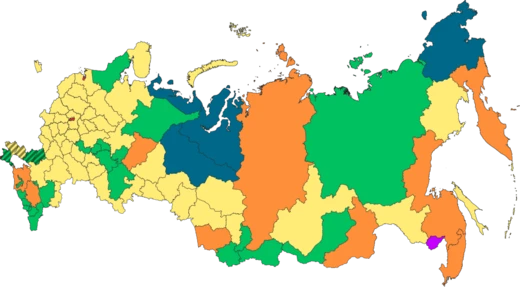
Chechnya
A North Caucasus republic with a history of resistance and conflict.

Chechnya, officially the Chechen Republic, is a republic of Russia located in the North Caucasus of Eastern Europe, between the Caspian Sea and Black Sea. It forms part of the North Caucasian Federal District and shares land borders with Georgia to the south and with the Russian republics of Dagestan, Ingushetia, North Ossetia–Alania, and Stavropol Krai. After the dissolution of the Soviet Union in 1991, the Checheno-Ingush ASSR split into the Republic of Ingushetia and the Chechen Republic, the latter proclaiming independence as the Chechen Republic of Ichkeria. Following the First Chechen War (1994–1996), Chechnya gained de facto independence, though de jure it remained part of Russia; Russian federal control was restored in the Second Chechen War (1999–2009). The republic covers 16,500 square kilometres, with a population of over 1.5 million as of 2021, predominantly ethnic Chechens who adhere to Sunni Islam. Grozny is the capital and largest city.
- Area
- 16,500 square kilometres (6,400 square miles)
- Population
- Over 1.5 million (2021)
- Capital
- Grozny
- Official Status
- Republic of Russia
- Ethnic Group
- Indigenous Chechen (part of Nakh peoples)
- Religion
- Primarily Sunni Islam
Lore & Background
According to the 11th-century Georgian chronicler Leonti Mroveli, the word 'Caucasus' derives from the Nakh ancestor Kavkas. George Anchabadze of Ilia State University notes that the Vainakhs are ancient natives of the Caucasus, with Kavkas as their legendary forefather, making them the most 'Caucasian' people in Georgian tradition. American linguist Johanna Nichols linked the Nakh-Dagestanian languages to ancient farmers of the Fertile Crescent, suggesting a direct continuation of the cultural and linguistic community that gave rise to Western civilisation.
Traces of human settlement near Lake Kezenoyam date back to 40,000 BC, with continuous habitation for some 8,000 years. The Caucasian Epipaleolithic and Neolithic eras saw agriculture, irrigation, and domestication of animals. Settlements near Ali-Yurt and Magas revealed stone tools, clay dishes, and clay brick structures; mountain settlements with stone walls date to 8000 BC. The wheel appeared around 3000 BC, along with horseback riding and metalworking in copper, gold, silver, and iron.
In the 14th and 15th centuries, Chechens fought Tamerlane and Tokhtamysh, culminating in the Battle of the Terek River. A Chechen princedom called Simsim emerged under King Khour II, who defeated the warlord Mamai at the Battle of Tatar-tup in 1362. Simsim was nearly destroyed during Timur's invasion in 1395. The 16th century saw Russian involvement: in 1558, Temryuk of Kabarda sought Ivan the Terrible's help against Vainakh tribes, and Ivan married Temryuk's daughter. Chechens converted to Sunni Islam over subsequent centuries, associating Islam with resistance to Russian encroachment.
Reader's Guide
Chechnya's significance lies in its long history of resistance to external powers and its role as a focal point of conflict in the North Caucasus. From the medieval kingdom of Simsim under Khour II to the wars against Tamerlane and the Russian Empire, Chechen tribes maintained a distinct identity and military tradition. The conversion to Sunni Islam became intertwined with anti-Russian sentiment, as seen in the rebellion led by Sheikh Mansur Ushurma in the late 18th century and the later Murid War under Imam Shamil. The 20th century brought the dissolution of the Soviet Union and the Chechen declaration of independence as the Chechen Republic of Ichkeria, leading to two devastating wars with Russia. The First Chechen War (1994–1996) resulted in de facto independence, but the Second Chechen War (1999–2009) restored Russian federal control, with Chechen politics dominated by Akhmad Kadyrov and later his son Ramzan Kadyrov. The republic's population remains overwhelmingly Chechen and Muslim, and its capital Grozny has been rebuilt after extensive destruction. Chechnya's legacy is one of fierce autonomy, cultural resilience, and ongoing integration within the Russian Federation.
Did You Know?
- The word 'Caucasus' is derived from the Nakh ancestor Kavkas, according to the 11th-century Georgian chronicler Leonti Mroveli.
- Traces of human settlement near Lake Kezenoyam date back to 40,000 BC, with continuous habitation for some 8,000 years.
- In 1362, Chechen King Khour II defeated the warlord Mamai at the Battle of Tatar-tup.
- The name 'Chechen' was used as early as 1692, predating the 1732 battle at Chechen-Aul.
More in Russian Federal Subjects 1-20
Spotted an error? Know more?
This is a living reference — every entry is fact-audited, and reader corrections feed straight into our audit queue. Suggest an edit · See this site's audit record