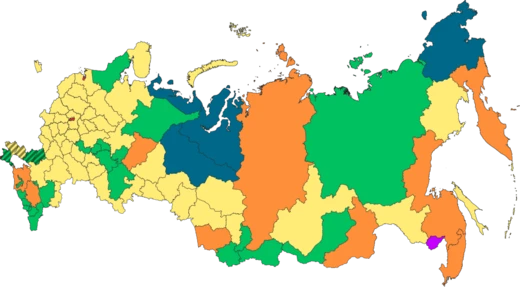
Altai Krai
A Siberian krai with ancient roots and a complex Soviet history.

Altai Krai is a federal subject of Russia (a krai), with its administrative centre in the city of Barnaul. As of the 2021 Census, its population was 2,163,693. The region is named after the Altai Mountains and is historically significant as a crossroads for nomadic tribes and ancient human habitation, including the Denisova hominin.
- type
- Federal subject (krai) of Russia
- administrative_centre
- Barnaul
- population_2021
- 2,163,693
- area_forests
- about 60,000 km²
- highest_point
- Mayak Shangina (2,490 m)
- established
- 1937 (by resolution of the Central Executive Committee of the USSR)
Lore & Background
The territory of Altai Krai has been controlled by several empires and khaganates, including the Xiongnu Empire, Rouran Khaganate, Mongol Empire, Golden Horde, Northern Yuan, and Zunghar Khanate. Bone fragments of the Denisova hominin were discovered in the Denisova Cave within the krai. After the Russian Revolution, the policy of war communism led to the peasant rebellion of Sorokino in 1921, which was crushed by the Red Army. During the interwar period, collectivisation prompted local resistance and migration of the Altai population with their herds to China and Mongolia. In June 1942, the krai was one of the territories where families of deported men from Eastern Europe, including Kola Norwegians, Lithuanians, and Latvians, were sent to GULAG hard labor camps.
Reader's Guide
Altai Krai holds significance as a region of ancient human habitation and as a crossroads for nomadic migrations. Its archaeological sites, including Denisova Cave, have yielded crucial evidence of early hominins. The krai's modern history reflects the upheavals of Soviet policy, from war communism and the Sorokino rebellion to collectivisation and the deportation of families to GULAG camps during World War II. Geographically, the krai features diverse landscapes from foothills to mountains, and its biodiversity is recognised by a UNESCO World Heritage Site. Economically, it relies on agriculture, lumber, and mineral resources such as lead, manganese, and gold. Politically, the krai transitioned from Soviet-era governance to a system with an elected governor and legislative assembly. The region's demographic trends show a declining population and a low total fertility rate of 1.24 children per woman as of 2024.
Did You Know?
- Bone fragments of the Denisova hominin originate from the Denisova Cave in Altai Krai.
- The highest point of the krai is Mayak Shangina, at 2,490 metres.
- In June 1942, families of deported men from Eastern Europe were sent to GULAG camps in Altai Krai.
- The krai's flag is derived from the flag of the Russian Soviet Federative Socialist Republic.
More in Russian Federal Subjects 1-20
Spotted an error? Know more?
This is a living reference — every entry is fact-audited, and reader corrections feed straight into our audit queue. Suggest an edit · See this site's audit record