Frequently Asked Questions
The most-asked questions about russian federal subjects.
What exactly is the 'Russian federal subjects' ensemble?
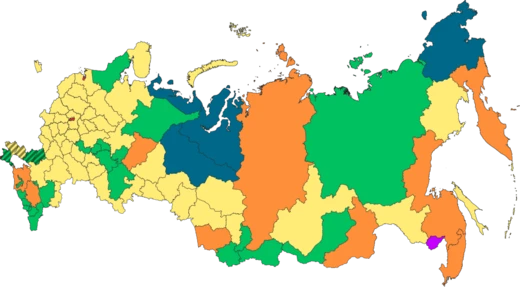
It is the collective of 89 constituent administrative units that together form the Russian Federation, each with its own government, capital city, and a defined degree of self-governance. Treat them as a large cast where every member plays a distinct role in a single federal story.
Who are the 'main characters' fans talk about most?
Moscow and Saint Petersburg consistently top the conversation as the two federal cities carrying the heaviest political and cultural weight. Republics such as Tatarstan, Chechnya, and Bashkortostan also get heavy spotlight for their distinct ethnic identities and special constitutional arrangements.
Where should a newcomer start reading?
Begin with the three federal cities and the most populous oblasts to grasp the basic hierarchy, then branch into the republics and autonomous okrugs where the cultural and legal diversity really opens up.
How many members are in the group?
There are exactly 89: 46 oblasts, 9 krais, 22 republics, 4 autonomous okrugs, 1 autonomous oblast, and 3 federal cities. The number has shifted only a handful of times since the 1990s.
What are the 'factions' or legal categories?
The six types—republics, krais, oblasts, autonomous okrugs, the single autonomous oblast, and federal cities—each carry slightly different constitutional standing and a different balance of local versus federal power.
What is the most notable 'power dynamic' within the ensemble?
Republics uniquely hold the right to establish their own state language alongside Russian and to adopt their own constitutions, giving them a semi-sovereign flavor that no other subject type possesses.
What is the key 'origin moment' for the modern group?
The current 89-member configuration was largely codified by the 1993 Constitution following the Soviet collapse, which formally defined the federation, its subjects, and the division of powers between center and regions.
Do all 89 interact on equal footing?
Not in practice—federal cities and large republics wield far more economic and political influence, while smaller autonomous okrugs in the Far North often struggle for funding and national visibility.
What is a recurring 'fan debate' about the roster?
A persistent discussion is whether 89 units is the right number, with some arguing for merging the smallest subjects and others defending the historical, ethnic, and geographic logic behind each one's continued existence.
What makes this ensemble distinct from other country subdivisions?
The coexistence of ethnically defined republics, geographically based krais, and purely urban federal cities under one federal roof is relatively rare worldwide, creating a patchwork where identity, territory, and politics all intersect in a single framework.